Monday, November 23, 2015

Jaisalmer: The Golden City

November 20, 2015
Currently: Jamming out to some Indian dance wedding music. It's loud and late, but it's a good thing I have this blog as an excuse to stay up!

I love Jaisalmer! Big surprise, I know. It's a whole different side of India. Driving in, the change was immediate. The landscape more desolate, the sunsets clear of pollution, the air drier. This desert town is known as the golden city and was once a stop along the Silk Road. It lies close to the Thar Desert and sits only 120 kilometers away from the Pakistan border. The city holds a mere 80,000 people (a blip compared to the rest of India) and only 2,500 of those live within the confines of the fort. We had the luck to be guided by a local who was born and raised inside the fort. As you'll see, the yellow sandstone along with the bright sun and desert backdrop help Jaisalmer live up to its nickname as the golden city. It's also a truly desert city. Our guide told us this summer the temperatures got up to 42.6°C (~108°F). You could make chapatis sans tandoor in that heat! I highly recommend a winter visit. It's still plenty hot and you can easily avoid the midday heat with some shade and a chilled lassi. I love lassi. I will miss lassi.

We took advantage of the early morning light and went first to the lake, which was very full due to a lucky monsoon season this year.
 a smart woman built this gate next to the lake and saved it from destruction by order of the king by putting a Hindu temple in the top bit
Ganga Sagar on the Gadsisar lake


Our next stop was the fort - the only livable one in India. The architecture was beautiful, and you can easily see the history ingrained in the walls. The first stop was the main courtyard where you can see the king's and queen's old homes. Immaculate on the outside, decrepit on the inside.
 the view of the royal residences from outside the fort

Winding through the fort's streets, it's easy to see why Jaisalmer is the site for many a Bollywood movies. The artistic structures and impressive monuments sprinkled throughout the city transport you back to another time. Further enriching this time warp is the Jainism influence. Another Indian religion, Jainism's hallmark feature is the principle of ahiᚃsa, or non-violence/non-injury. The most devout Jains take on this principle to include all living things, refusing to eat root vegetables for the mere act of retrieving the vegetable injures the insects that live there. We were lucky enough to visit a stunning Jain temple with carvings reminiscent of the Khajuraho temples.

detailed carvings
 an idol

The rest of the day was spent meandering through the narrow streets and enjoying the daily life before heading out on our camel safari. Yeah, we did the camel safari thing. We are good tourists after all. All of 30 seconds on that thing brought me back to my last camel ride. Camels are not comfortable. I think I'll opt for a horse ride next time around. The desert landscape itself was a bit different than what I was expecting (this expectation was definitely set by last year's desert excursion in Morocco). There wasn't just some giant sand dune that you got lost in.

There was a special couple of minutes where all of us meandered down to the sunset spot and simply sat in silence with our cups of tea. Complete silence. In India. I know... I didn't believe it was possible here either. Those of us who have been here for two months truly appreciated that time and took it all in. 
A striking sunset, a solid campfire dinner, a bit of alcohol, and some Lisa sand drawings entertained us for the rest of the evening. There's nothing that can really beat stargazing in the desert for a night. The whole evening was exactly what I'd hoped it would be and more. Shout out again to the wonderful people with me on the trip!

And because a campfire is never complete without a ghost story. Welcome to Kuldhara, the now deserted village where a thousand people vanished overnight. 
All for one chief's beautiful daughter.

Legend has it that a minister fell in love with a local chief's daughter and demanded he wed her. With pressure from powerful sources, the chief was given two days to decide. Instead of responding, the minister came back to a deserted town. Thousands of people disappeared overnight. To this day, few dare to tread through its crumbling walls. Never at night. This story caught the attention of Delhi's Ghost Busters (okay, their Paranormal Society. yes, really) who risked an overnight stay. The most terrifying night of their lives. Using their Ghost Box, they spoke to the spirits - even capturing the names of some. They witnessed instantaneous and baffling drops in temperatures, haunting voices, children's handprints on the cars, and unexplained moving shadows. Would you dare spend a night?

In other news... the village made their huts out of cow shit. As we were told. Many times. Cow shit. Lots of it. I reckon they scared the cows shitless with their haunty ways and needed some use for it all.

A house of cow shit. Pretty though, right?

We've got one more colorful city left, and I'll leave you guessing which color it could possibly be.... India is colorful for sure. In more ways than one!


Lots of love,


Lena

Friday, November 20, 2015

Delhi...and some rats for good measure

November 18, 2015
Currently: Dusty... very, very dusty.

End of part two of three came and went with Delhi. We had to say goodbye to some really incredible people - Kerry, Rachel, Emma, Glen, and Elaine! They were all such great fun to have on the trip and it was sad to see our time together come to an end. I wish everyone safe journeys onwards for those continuing their travels and safe flights home for those ... well going home!

Delhi is very metropolitan (many plus points for their insanely awesome metro system). It definitely went against all my expectations. I was expecting a more Kolkata-like experience, especially when the second we got off the truck we were accosted, and I do mean accosted, by a small child beggar. She was daringly aggressive, going so far as to grab our legs, clothes, bags and refused to leave even with hotel staff chasing her away. It was both heartbreaking and maddening. It wasn't like the other beggars we'd witnessed before. This was targeted and almost barbaric. I feel awful using words like aggressive and barbaric to describe the actions of a child, but it felt that way. To know that this child has been raised to act like this towards foreigners is distressing. I feel so helpless in these situations. What should I do? Is there even anything I could do? I know it's a part of traveling, but I will never get used to it. On principle I never give money to beggars, because I don't want to contribute to any sort of begging scam or culture. The begging industry in India is real and ever so complex. Just to give you some ideas of numbers, India has been quoted as having the highest level of child labour in the world, accounting for 7% of its workforce with estimates from 20 million in total up to 44 million children out of school and at least 300,000 of them as beggars (Child Labour in India - An Overview; Child Labour in India). The reality is many of the families of these children rely on the income produced by the child, whether they are working jobs or simply begging on the streets. The begging industry has been estimated to reel in Rs 1.5 billion (~$22.6 million) in Delhi alone. But, let's not forget the Slumdog Millionaire reality either (recap: gangs maim, throw acid on, blind, threaten/torture, underfeed children to increase begging profits). I could never live with myself if I unknowingly contributed to any business that forces these conditions on children. Looking back on that girl with caked hands, mangy hair, and wild eyes, I haven't seen that level of desperation before. Especially not in a kid. It pulled at my heartstrings and made me wonder the story behind the desperation.

Sorry for the dark tone, but it's not something I wanted to overlook. It's better to have a conversation (or at the very least, one-sided commentary) about it, than to simply brush it under the rug. But for now, I want to move on to all the other sights and impressions Delhi made on me. We had a wonderful day tour through Old Delhi that began with a visit to the largest mosque in India, Jama Masjid. It was kind of expensive to take photos there, so you'll have to google some images to see what I saw! Or visit Delhi. Much better idea. We also checked out some spice markets and climbed up on top of a terrace to get a beautiful view of some old colonial style buildings.
 a glimpse into Sunday mornings in Old Delhi
 dried pastas and other Indian things
colonial rooftop view

After a fuel stop at a famous paratha restaurant, we continued to the Gurudwara Sis Ganj Sahib, a Sikh temple. The gurudwara (literally translated as Gateway to Guru) is a place of worship for Sikhs that oftentimes contains a hotel, kitchen, and school. Our guide was Hindu, but couldn't stop singing the praises of the Sikhs. He told us Sikhs are by far the best "kind" of Indians. He described them as a hard working lot with giving souls. You will never find a Sikh beggar, a lazy Sikh, or a heartless Sikh. So what is it about Sikhism? It actually sounds like a lot of other religions. Sikhism is a monotheistic religion originating in the 15th century. Its preaches truthful living, selfless service, and social justice for all. The difference is their practices wholly mirror these words. The temple is the perfect example. It is open to anyone regardless of race, religion, or caste. Sikhs and volunteers host meals several times a day feeding over 40,000 mouths every day free of charge to anyone. The temple also has a hotel, where people who have lost their job or are visiting Delhi can stay for highly discounted rates. It's a fascinating religion and one that other religions should be taking pointers from.
 at the impressive rate of 3,000 chapatis/hour - all by volunteers!
free food for everyone

Besides scouring the Janpath Market for souvenirs, my last exploration around Delhi was of a slum also known as Sanjay Colony. This colony is more of a community that survives on two key industries - clothes recycling/manufacturing and the factories that surround the slum. Its narrow alleyways and sewage-ridden streets are abound with children playing and adults running their small shops. Really not much different to daily life in Delhi. Despite the filth and general lack of basic human necessities, people are happy there. Even when they have the money to, they don't leave. They have what they need and the community is that invisible and unbreakable tie that binds it all together.

As a bonus we got to visit the Karni Mata Temple, home to 20,000 holy rats. Karni Mata is actually a Hindu woman worshipped by people as being a reincarnation of the goddess Durga. One of the folklores goes that 20,000 men ditched their service in the army before a battle and escaped to Deshnoke. Upon arrival, Karni graciously spared their lives and sentenced them instead to life as rats, providing this temple as their home. The army was so grateful for their twist of fate that they all promised to serve her devotedly.
line of Indians waiting to get in - foreigners weren't allowed inside the temple itself
they are cute.......not

So that's Delhi. And the rats. I'm ready to start my Rajasthani experience. More to come soon on the wonders of a golden city!

Lots of love,

Lena

Sunday, November 15, 2015

Jaipur: The Pink City

November 14, 2015
Currently: In denial that I've almost completed two-thirds of my trip!

En route to Jaipur, we stopped by another palace created by Akbar. Quick recap: he's the grandfather of the man who ordered the construction of the Taj. You might also remember him as the Mughal's very own royal casanova. We ended up visiting another one of his palaces, Fatehpur Sikri. Despite all of his womanizing, Akbar had some serious problems conceiving a male heir. He tried everything, including a visit to a renowned holy man named Salim Chishti deep in the desert. With Salim's blessings, Akbar finally received a son. His gratitude was so great that he decided to build a new city in his honor. Because that's what Akbar does. He builds things. Fatehpur was only the capital for fourteen years before Akbar moved the capital to Lahore, claiming a water shortage in the area as the reason. Historians, however, debate that it was a political move to stifle an impending rebellion in Lahore. My personal theory is that he wasn't happy enough with his 800 concubines in Fatehpur. That's 4,200 shy of his Agra palace numbers. Now the place resembles a ghost town... well a ghost town filled with tourists during the day and local boys playing hide-and-seek at night.

 the main complex area
 Buland Darwaza - the main entrance into the palace, the highest gateway in the world (because Akbar doesn't do second best)
Jama Masjid - mosque on the left and the white tomb of the holy man Salim Chishti on the right

I love architecture. I've totally been nerding out this whole trip. At the end of this trip, I really should count how many UNESCO World Heritage sites I made it to. Anyways, on to Jaipur which is known as the Pink City of India. A long time ago, some king decided he wanted his city to look nice for Queen Victoria so he decreed that everyone paint their houses pink. Our first photo stop, the Hawa Mahal (translation: Palace of Winds), gives you a great example of that iconic pink color. Excuse the Diwali decorations!
Our next stop was the Am(b)er Palace, which has more amazing architecture.
a section of the Ganesh Pol Gate couldn't believe the quality and intricacies of this artwork
Sheesh Mahal, the mirrored palace - the definite highlight of the day for me!
view from the fort

Another quick photo stop was necessary to capture the ever famous Jal Mahal or Water Palace.
Next was the observatory Jantar Mantar, where our tour leader, Kate, geeked out on some science. To be fair, it was super cool. This place looks like a playground for grown ups, filled with 19 astronomical instruments that are exceedingly simple and exceedingly complex all at the same time. It has the world's largest sundial accurate to two seconds, a pole star locator, and lots of other nerdy stuff that give information about location of planets and stars in relation to Jaipur. My favorite moment was standing around in the heat arguing over the accuracy of birth charts with the tour guide. After much circular discussion, our final conclusion came to this: If it's not accurate, they did it wrong.
largest sundial

Our final stop was the City Palace, which holds more impressive architecture and courtyards inside. We were pretty knackered at this point... you know with all the arguing about astrology in the sun... so my enthusiasm was pretty low. But it's a staple tourist destination in Jaipur so we trudged our tired, sweaty selves around the museums and courtyards. I did quite enjoy the beautiful gates in the Pritam Niwas Chowk. Four gates for four seasons and Hindu gods. Really beautiful work! I also enjoyed the irony of being able to take photos of the Hall of Private Audience but not the Hall of Public Audience.
 Chandra Mahal - the most commanding building in the complex; the building behind it is where the Royal family lives when it visits Jaipur
Southwest Lotus Gate dedicated to Lord Shiva-Parvati and representing summer

Jaipur is a beautiful city filled with so much history. It was a great last hurrah for the group before the official end to the second leg in Delhi. It's crazy to think how quickly it's flying by. I'm already close to only two weeks left here in India and I'm trying to soak up as much as I can without wearing myself down. Touristing is exhausting! But don't take that as any sort of complaint. It's just more motivation to keep on keeping on. I love India and I don't want to miss out on any possible experience. Especially considering me sitting around doesn't make for good blog posts.

Lots of love,

Lena

Friday, November 13, 2015

The Taj! And Diwali!

November 12, 2015
Currently: Pondering my next big life goal... Pyramid of Giza? Burma? Petra? Namibia? The world is too big.

Writing this is a little surreal. Have you ever said you were going to do something, but that something always seemed out of reach or improbable in any sort of near future? Well the Taj was always that for me. A distant dream that I knew someday, somehow I would go see. But I did it. I've done it. It happened. To know that I've completed that life goal, I feel empty not having that almost-but-not-quite unachievable goal lingering in the back of my mind. The planning for this trip began twelve years ago and its culmination was always the Taj Mahal.


We had a jam-packed day in Agra, and it started with a sunrise over the Taj. Waiting in line at the gate was almost torturous! I distracted myself by guessing exactly how many minutes it would be until I realized my childhood dream. "Twelve minutes... no fifteen. Okay, definitely not more than twenty. Twenty minutes until I see the Taj!!!!!" I felt giddy walking through the main gate to the iconic view. When I finally saw it, it took my breath away. The haziness of the early morning couldn't diminish the dominating presence of the architecture. 

The Taj is another one of those tragic love stories. The Mughal king, Shah Jahan, ordered the construction of the Taj Mahal (translation: Crown Palace) as a mausoleum for his favorite wife. I was lucky enough to capture the sun rising out of the haze for some stunning photos. This place is so incredibly photogenic - no bad angles to speak of!
can't believe my camera took this photo!
the dedication of that stone inlay and carving design boggles my mind
classic reflection shot. and it's all mine!

After the Taj, we went to our guide's home where his family had prepared a classic Indian breakfast. In true Indian fashion, it was delish! I don't know if I can go back to a simple bowl of oatmeal in the morning. The curry was too spicy for me, so I improvised and made curry infused yogurt, which was quickly scooped up with puri. Weirdly enough, white bread with butter (it was seriously good butter) was the most popular part of the breakfast. Typical...
Afterwards, we continued onwards to a marble factory so we could learn why Indian marble is so precious. The marble is unique in that it is both nonporous and translucent. The translucent bit is really cool because if you shine a light on the stone inlays, they glow brilliantly. The process of inlaying stone and cutting and shaping the marble is almost unbelievable. They hand grind each near-microscopic petal for each flower. It takes at the very least months (if not years or decades) to put together any marble artwork. It definitely made me appreciate the work put into the Taj!
 that dot on his finger is a petal he's shaping

The second big tourist trap in Agra is the Agra Fort. This fort was built by Shah Jahan's (think Taj Mahal) grandfather, Akbar. Akbar is a really, really big deal. Like three wives and 5,000 porcupines...I mean concubines... big deal. He built five different palaces around India and this was one of them. The building is beautiful and holds so much history. Shah actually was placed under house arrest in this fort by his son for the last eight years of his life. An area within the palace is known as his golden prison.
a room in Shah's golden prison

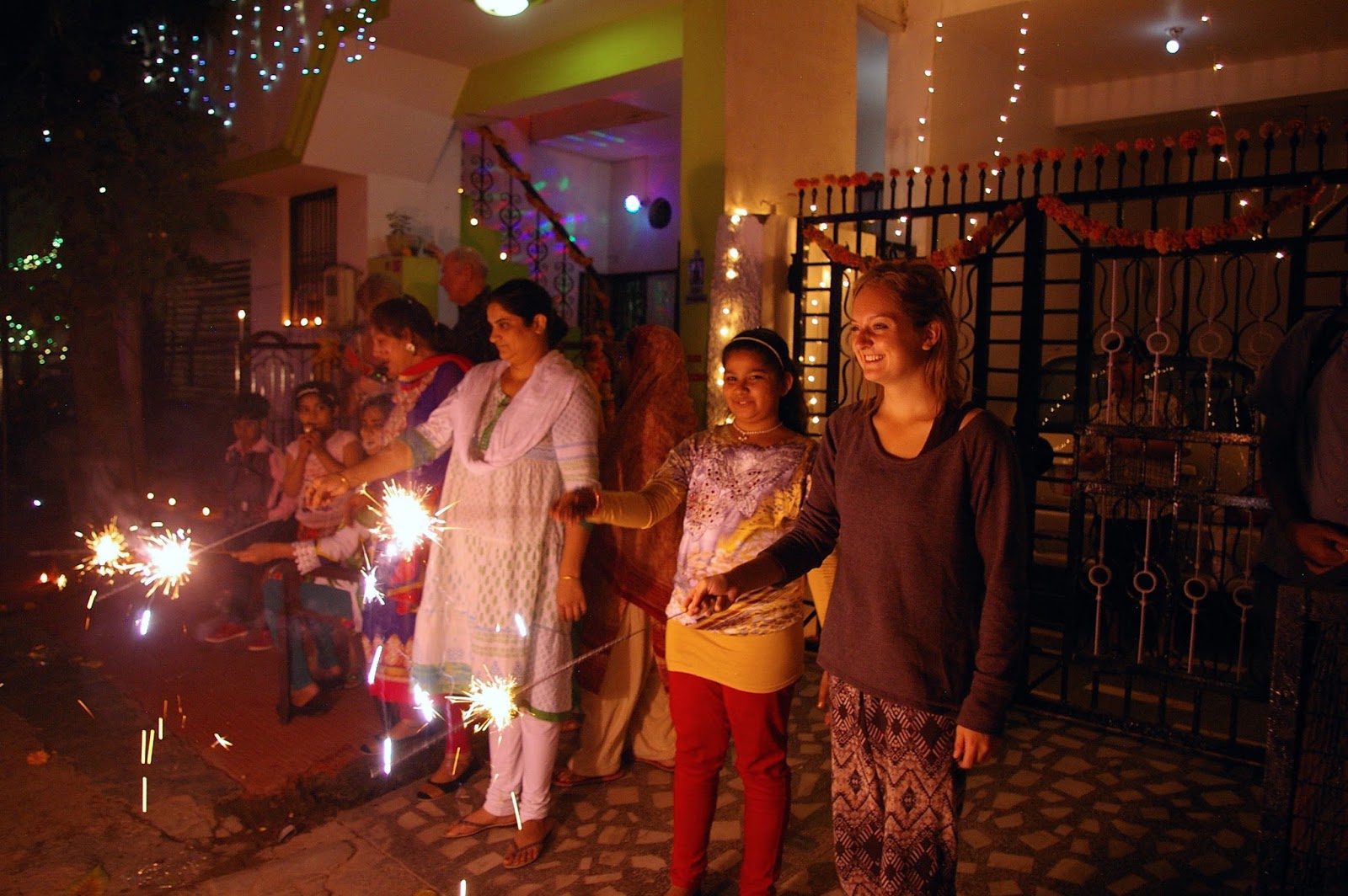
We ended our day with a celebration of Diwali! Diwali or the Festival of Lights is the biggest celebration in India. Families give gifts, buy new clothes, decorate their homes with lights and candles, eat too many sweets, and set off fireworks in the night. It celebrates light over darkness, hope over despair, good over evil. And somehow, to top off this already perfect day, we managed to get our foreign selves invited into the home of a jeweler we had visited earlier in the day. His family gave us drinks, sweets, tons of sparklers, and an amazing hour of loud merriment. I found out that I kind of like causing ruckus in the streets. It was so special to have total strangers share their holiday with me. That Indian hospitality is back again!
sparkler frenzy!
no holding back with fireworks

November 11, 2015 is the day I officially fell for India. It began by fulfilling a lifelong dream and ended with a remarkable celebration of happiness, life, and generosity. India, you've given me the perfect day and I will forever remember it as one of the best days of my life! Thank you, thank you, thank you!

Lots of love,

Lena

Thursday, November 12, 2015

Khajuraho (& Orchha): Oh... thoooose temples

November 10, 2015
Currently: Antsy, as I'm in THE city home to the Taj Mahal. Dream realized! Oh yeah, and it's Diwali. So add a lot of sugary treats and fireworks to that antsiness.

Let's add a little spice to this blog, shall we? I need to forewarn everyone and say these images are definitely not suitable for all ages and leave it at that. I highly recommend really investing some time into studying the pictures I post today. Some will be subtle. Others will not.

Khajuraho is the ancient capital of the Chandela dynasty, who liked to spend their time constructing beautifully articulate Hindu and Jain temples. Because of these temples' remote location, they were lost to the world until some Brit discovered them in the early 1800s. The temples are considered one of the seven wonders of India and are even more impressive on arrival. Case and point:

But what's really unique about these temples is their honest depiction of life in the 10th century through the sculptures. Our tour guide was the humble translator of these temples. He turned facial expressions, symbols, body language, dress, really anything you can think of into a story of everyday life. What I found interesting is that historians judge the freedom and quality of life within certain time periods by focusing on how women are portrayed. Hindu women have had varying levels of freedom throughout Indian history, oftentimes dependent on the influence of Islam in the region. Clues about education, literacy, and status are hidden in these sculptures. For this era, they tell a story of a modern woman; one that wears trousers, smiles, dances, even writes love letters. Chandelas knew how to treat their women!

Okay, enough boring history stuff already. I know why you're really reading this post. The real treat of these temples is the highly imaginative erotic carvings. No way to avoid them really. Those Chandelas did have a sense of humor about it too. Let me give you an example, so you know what I mean. Imagine two rows of four beautifully carved elephants facing each other. A closer look confirms that one elephant is looking off to the side with an amused expression on his face, clearly distracted. What, pray tell, caught his attention? You tell me.
Naughty elephant. Well here's a few more pictures of the temple, because I did end up becoming entranced by the temples' beauty, took way too many pictures, and I'm feeling indecisive. No need to read into the number of pictures I took...
just a little beastiality thrown in for good measure

Our crew then made the decision to head out of Khajuraho a day early to explore the amazing palaces of Orchha. This place is a little palace happy. We ended up exploring just the main Orchha fort complex, specifically the Jahangir Mahal and the Raja Mahal. The Jahangir Mahal is considered one of the finest examples of Mughal architecture. And, I got it at sunset!
Raja Mahal
Another palace outside the complex
 Jahangir Mahal

Just wanted to add a comment on a little something I experienced in both Khajuraho and Orchha called Indian hospitality. I met two Indians: Arman, a twenty-two year old math student, currently studying in Dehli but back in Khajuraho to celebrate Diwali with his family; and an nameless stranger, twenty-eight, who owns a little shop of trinkets and bought me a cup of chai tea in exchange for some conversation in the back of his friend's sweet stall. The conversation topics ranged from personal life stories to politics to favorite festival traditions. I know I've said this before, but I wanted to emphasize that these are the moments that are unforeseen joys of traveling. A small cup of chai and curiosity are all you really need for a meaningful and rich conversation.

I also got to dip my toes into a true overlanding experience by signing up to be a part of the cook group. Normally when you overland, you camp. A lot. India is a bit different for Dragoman since we stay in hotels the entire time with some camping interruptions. However, for our night in Orchha, we all cozied up together in a hotel's backyard and decided to make use of Daisy's cooking facilities to make dinner for ourselves. Rachel, Kerry, Elaine, and I all volunteered to get the ingredients. With the help of some young locals, we went around Khajuraho to grab fresh ingredients or a dinner and breakfast for eleven people. It was so much fun running around town and pulling everything together!
After our day in Orchha, the cook group got together to clean, chop, boil, and season our ingredients into a delicious meal of veggie pasta. The ensuing conversation sitting around enjoying our meal was by far the best part of the evening though. A few drinks encouraged the rowdy conversations and bouts of laughter that surely kept our neighbors up all night. We learned a lot about each other. Like for example, you should never let Rachel read your texts out loud. Just ask Emma. The morning meal consisted of Kerry's delicious eggy toast, bread and jam, pineapple, and watermelon. Overlanding is an experience and I'm glad we had that opportunity to experience it more authentically. I've already decided I need to give overlanding another try to get the full experience. Now...where to go...

Lots of love,

Lena